
A brief, not a wish
Three quotes arrive for the same item: a wooden hanger for a hotel room. The cheapest is less than half the most expensive. The buyer reads this as a pricing problem, or as one supplier being sharper than the others. It is usually neither. Three suppliers received three different sentences, and each quoted what it understood.
A specification sheet fixes that before the first email. It is the one page where the order stops being a conversation and becomes a set of numbers both sides can check.
What is a hanger specification sheet?
It is a one-page description of the item you want to buy, written in fields a factory can quote and a buyer can inspect: wood, shoulder profile, body length, finish, logo and packing. Each field carries a value and a tolerance. It is not a marketing brief and not a drawing.
Why do supplier quotes differ so much for the same hanger?
Because most briefs name a category instead of an object. "45 cm wooden hanger" describes a length and ignores the three variables that move cost hardest: body thickness, shoulder profile and finish. Suppliers fill the gaps differently, then quote different products. The spread is not margin; it is specification.
The sheet does not have to be long. Six fields, one page, and a physical sample for the items where text runs out. What follows is the sheet we use for quotation, field by field, including where it usually stays silent.
The six fields every hanger RFQ needs
What should a hanger spec sheet include?
Wood species, shoulder width in millimetres, body length and thickness, finish, logo method with position, and packing. Add quantity per model and colour, destination, and the date the goods must arrive. Those six fields decide roughly ninety percent of the unit cost; the rest is logistics.
The six fields, and what each one controls
Two things are deliberately missing from the table: price and lead time. Both are outputs. Suppliers who quote before the six fields are settled are quoting a guess, and the guess is usually the cheapest version of your sentence.
The full method behind these fields — how wood, profile and logo interact — is set out in our hanger specification guide. This page is the shorter instrument: the sheet you send.
| Field | What to write | What it controls |
|---|---|---|
| Wood | species + state it will be finished from | cost band, stability, colour depth |
| Shoulder | width in mm + profile shape | garment support, mould or profile cost |
| Body | overall length + thickness, both in mm | garment type, hanger weight, rail space |
| Finish | gloss / matt / satin + sample reference | appearance, durability, drying time |
| Logo | method + position + tolerance | tooling, unit cost, proofing lead time |
| Packing | polybag or wrap-free + label rule | warehouse handling, carton count, cost |
Field 1 — wood species is a specification, "wood" is not
Does wood species matter for hangers?
Yes, in three ways a buyer feels later: how the hanger takes the finish, how it behaves when a room dries out in winter, and how the colour reads on the rail. "Wooden hanger" tells a factory nothing it can quote. The species name tells it which line to run.
Which wood should a hotel hanger use?
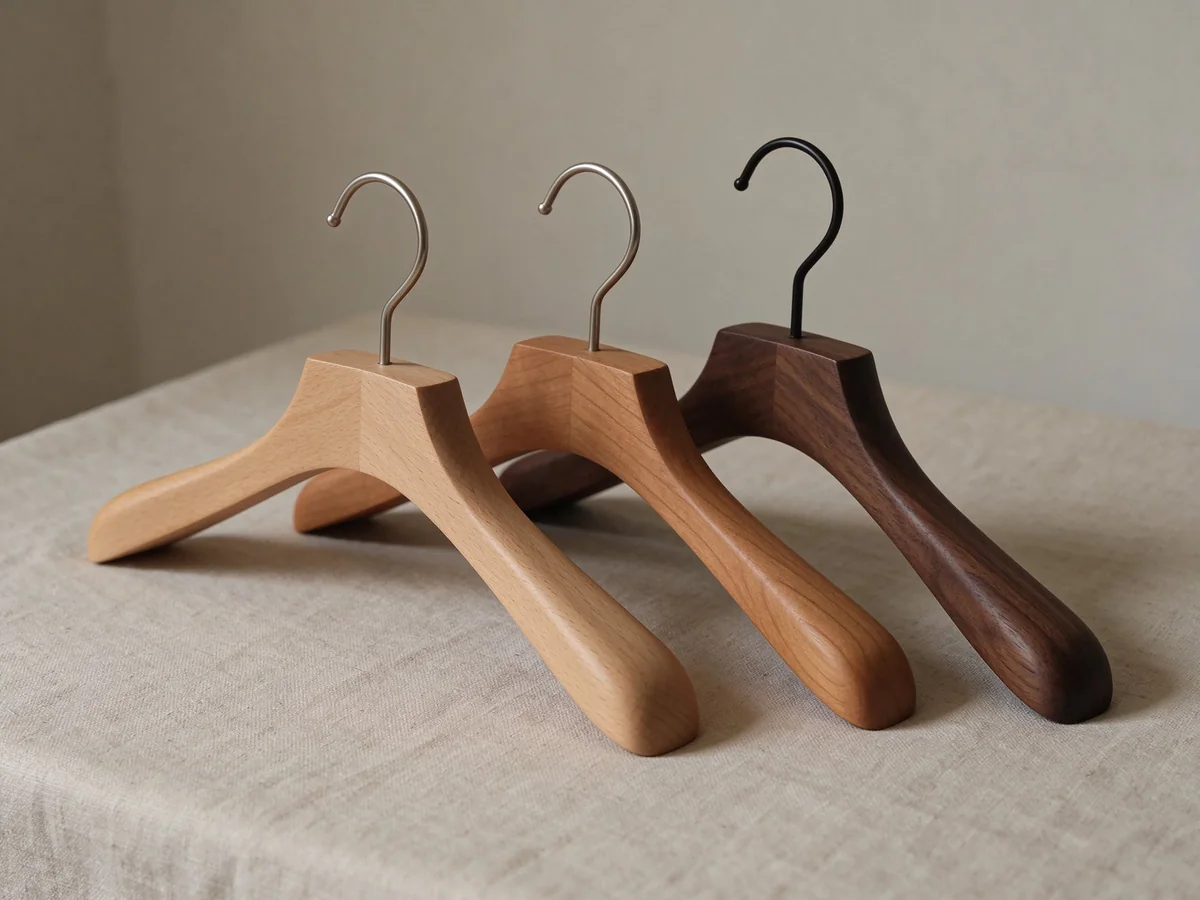
Beech for a tight, uniform grain and a clean clear-lacquer finish; lotus for a darker tone at a lower unit cost; walnut where the hanger is part of the display and the grain should carry the piece. For guest rooms, beech is the usual choice because replacement batches match more predictably.
Colour is the field that most often gets written as an adjective — "natural", "dark wood". Neither can be quoted. Send a Pantone reference or a physical sample and say which light the colour will be judged under, because a bathroom light and a shop spot read the same lacquer differently. Our customisation page sets out how the three decisions of wood, finish and logo are priced together.
Species is also the first cost lever, before anything is cut. Beech costs more than lotus at the same dimensions, and the gap is not a supplier's mood: it is the price of the board plus the yield after defects are cut out. A sheet that names the species lets a factory quote the board; a sheet that says "wood" invites whichever board is cheapest that month.
One more thing belongs in this field, and almost never appears: the moisture state the wood is expected to hold when it ships. Hangers that move after painting usually moved because the wood was not stable before it, not because the lacquer failed.
| Wood | Hand and grain | Colour direction | Typical use |
|---|---|---|---|
| Beech | dense, tight, even grain | pale to warm mid | guest rooms, retail rails |
| Lotus | lighter in the hand | darker than beech | volume orders, cost-led ranges |
| Walnut | dense, open figure | dark, warm | display, suites, luxury retail |
Field 2 — shoulder width and the shape behind the number
What is the difference between a 42 mm and a 45 mm shoulder?
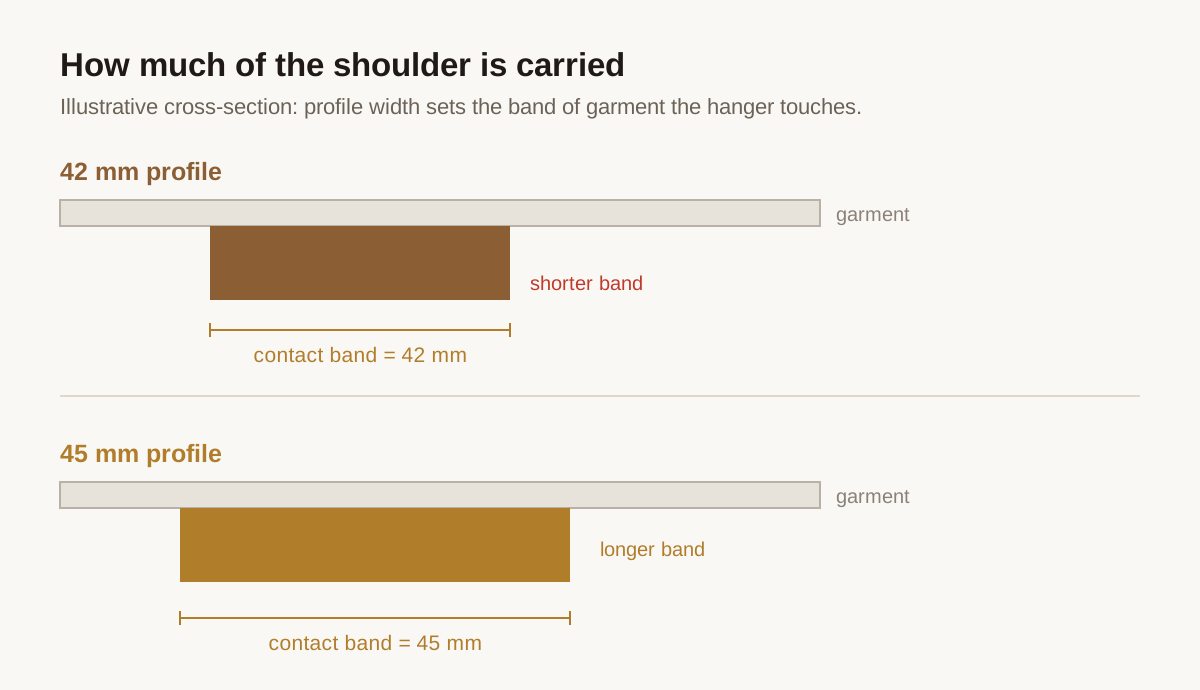
The profile width sets how much of the garment's shoulder the hanger actually supports. A 42 mm shoulder carries the jacket over a narrower band; a 45 mm shoulder spreads the same weight over a wider band under the shoulder line. Neither is better. The difference is how concentrated the load is, not which hanger is stronger.
Why the profile matters more than the length
A hanger's body length is visible in a photo. The profile is not. Buyers specify 420 mm and consider the job done, then discover that a 12 mm body with a 42 mm shoulder behaves differently from a 14 mm body with a 45 mm shoulder on the same coat. Length sets how far the hanger reaches; profile sets how broadly it bears the weight. The two numbers are not interchangeable, and a sheet that gives only one of them is describing half a hanger.
The profile is also where a custom order gets more expensive. A different shoulder shape means a new profile, which means a sample run before production — that is the 7–15 day sampling window, not a delay invented by the supplier.
How do I measure a hanger I already have?
Lay it on paper and mark the two outer tips for body length; measure the profile at the outer shoulder with a caliper rather than a ruler; note the hook type and whether it swivels. Three measurements and one note describe the item well enough for a quotation, and they take about two minutes.
Can I specify a custom shoulder profile?
Yes, with a physical reference. Send one hanger you already like, or a garment the hanger must carry. We photograph and measure the reference, confirm the profile in a drawing, and sample against the drawing. For standard orders the profile is fixed, which is why standard lead time is shorter: 25–35 days after artwork, against 40–55 days for a full cycle with new tooling.
If the range is built around jackets, the wide-shoulder format carries most of the volume; see wide-shoulder suit hangers for the two standard profiles we keep in production.
Field 3 — body length and thickness
What body length should a hotel hanger be?
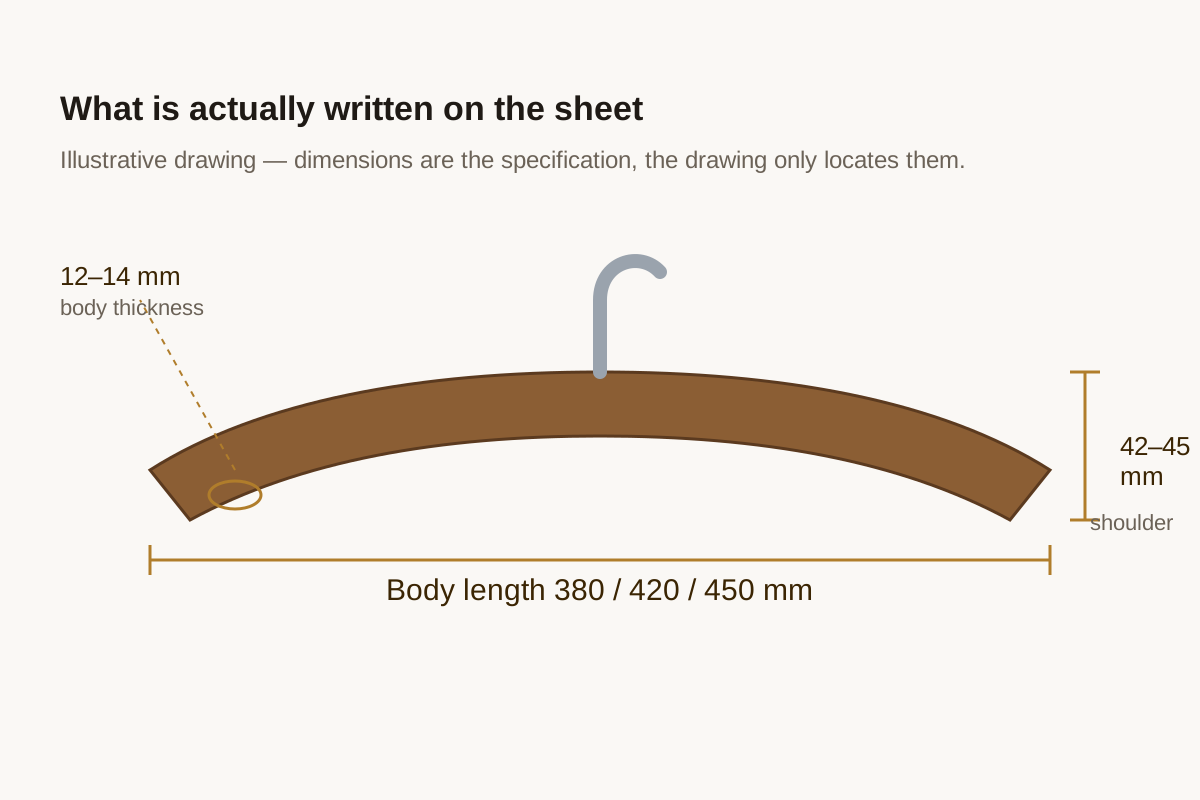
380 mm for shirts and light jackets, 420 mm as the working standard for guest rooms, 450 mm for coats and outerwear on a rail with space. The number should follow the garment list, not the wardrobe. A 450 mm hanger in a shallow wardrobe wastes space and reads oversized on a shirt.
How thick should a wooden hanger be?
Thickness is two numbers, and both belong on the sheet. Overall thickness — 4.5 cm and up for coats, about 3 cm for knitwear, 2–3 cm for shirts, 2 cm or 1.2 cm for T-shirts — sets the support band and the carton count. Panel thickness is the wood itself, 12–14 mm on our solid wood lines. When a quote is unusually cheap, both are the first fields to check.
Length and thickness are also where a sheet usually contradicts itself. A brief may say "45 cm" for a coat hanger and separately ask for "hotel standard" — two specifications that imply different garments. Write both numbers, and write the garment list next to them.
The hook is a field, not a fixture
Most sheets leave the hook out, then discover at sample stage that it matters. Chrome-plated iron with a 360° swivel lets a guest turn the hanger on the rail; a fixed hook does not; a security hook with an oval ring only lifts off a matching rail, which is how hotels reduce losses. Which one you need follows the room, not the hanger. State the rail diameter too: a hook that hangs loose on a 25 mm rail and one that binds on a 38 mm rail are the same hook on paper.
Clips and trouser bars are separate decisions that ride on the same sheet. A clip hanger needs clip type, padding and tension stated; a trouser bar needs the bar section and whether it is plain or rubber-coated. Write the accessory in the same row as the model, or it becomes a second order.
For room-block programmes the length mix follows the room mix; the per-room-type quantities are set out on the hotel guest-room hangers page and in the hotel programme section.
Field 4 — finish is a sample, not an adjective
What finish should I specify for wooden hangers?
Gloss, matt or satin, named as one of the three, plus the sample the colour is judged against. Matt absorbs the spot and hides handling marks; satin keeps a slight sheen on the shoulder; high gloss reflects the light source and shows every fingerprint on a shop floor.
How do I approve a colour match?
Against a physical batch sample, under the light the product will live in. Approval by photograph does not hold: two phones with different white balance produce two different colours from one hanger, and a glossy finish photographs badly in a lookbook regardless of how it looks in the room.
Write the approval condition into the sheet. "Matched to sample A under 3000 K display lighting" is a sentence a factory can act on. "Natural wood colour" is not.
The finish is a system, not a colour. A clear matt and a coloured matt on the same board are different processes with different drying times, and the same colour name reads differently on beech and on lotus. If the finish has to match an existing rail, say so — matching an existing finish is a sample job, not a colour code.
This is the field where the difference between a quote and a complaint is decided. The quality page describes what a batch has to pass before it ships; colour is one of the checks recorded per batch, against the retained sample rather than a new one. Boutiques tend to notice finish before they notice anything else, which is why the boutique programme treats the finish sample as the first approval, ahead of the logo.
Field 5 — logo method, position and tolerance
Where should a logo go on a hanger?
On the shoulder face, in the flat area between the neck and the outer shoulder, where it is readable at arm's length without being visible to a guest from across the room. Hotel programmes usually want it subtle; retail brands usually want it seen. Position is a brand decision before it is a manufacturing one.

Which logo method belongs on the sheet?
The method is decided by handling, not by preference. Our standard is laser engraving with a gold fill — the mark is cut and the recess filled, so it reads by depth and contrast and survives handling without tooling. Bare engraving is the quieter version of the same cut; a metal nameplate reads as metal and carries a one-off die cost; hot stamping is the lowest unit cost and the least durable where the shoulder is handled. Price and durability for each method are set out on the custom logo hangers page; the sheet needs the method plus three numbers.
What tolerance applies to logo position and depth?
Position should be stated in millimetres with a tolerance, and depth stated as a target rather than a range, because engraving depth is set by the toolpath. State the tolerance you need, and ask the supplier to confirm it in writing at quotation: a position figure and a depth figure, not a promise that the mark will "look centred". If the brand guidelines set a tighter position rule than the process can hold, that is better discovered at quotation than on the sample.
The methods fail differently, and the sheet should say which failure you can live with. A gold fill can sit unevenly if the recess is cut shallow; bare engraving can show tool marks on a soft grain; a nameplate can lift at a corner; hot stamping can wear at the point where a hand grips the shoulder. None of these are defects when they are written into the acceptance criteria, and all of them are arguments when they are not.
Private-label programmes usually specify the logo method, position and the carton print together, because both carry the brand. Our private-label page covers how the two are proofed in the same round. Where the hanger is part of a display rather than a stock fixture — the case in luxury retail — the logo is usually specified at the smallest size the brand will accept, because a large mark under a spot reads as signage.
Field 6 — packing, labelling and the carton nobody briefs
How should hotel hangers be packed?
Three options cover most orders: polybag per piece, wrap-free with cardboard protection between shoulders, or tissue wrap for display pieces. The choice changes packing labour, carton count and the condition the hangers arrive in — and it is the field most often left blank, so it is decided by the supplier.

Can cartons be labelled per room block?
Yes, and for a hotel programme they usually should be. Labels can carry the SKU, the model name, the floor or the room block, so a rollout ships as separate units instead of one undifferentiated pallet. The label content has to be agreed with the property, because a label that means nothing to the receiving team is worse than no label.
Packing and labelling record
Packing also decides who absorbs the labour at the other end. Wrap-free cartons with board protection are faster to unpack and produce less waste; polybagged pieces take longer to open but travel better through humid ports. Say which constraint matters more — unpacking time or transit protection — and the option chooses itself.
Two practical points. First, carton count is a quotation input, not a detail: 1,035 hangers at the carton count quoted for that hanger thickness — about 50 for a 1.2 cm frame, about 35 at 2–3 cm, about 20–25 at 4–4.5 cm — and that number decides pallet height and freight. Second, if the goods ship to a distributor rather than a hotel, the carton text may need to avoid brand marks entirely — the distributor page covers that case. Specification sheets for each of the five product lines can be requested from the downloads page, and the commercial answers — minimums, lead times, terms — are collected in the FAQ.
| Item | Options | Who confirms |
|---|---|---|
| Carton print | printed / labelled / plain | buyer |
| Label content | SKU · model · floor or room block | buyer + property |
| Units per carton | fixed count, typically 50 | factory, quoted |
| Inner protection | polybag / wrap-free with board / tissue | buyer |
The worked example: one hanger, three sheets, three quotes
How do I compare hanger quotes fairly?
Normalise the sentences first. Take each quote and rewrite the line items into the six fields; where a field is missing, ask. Two quotes can only be compared when they describe the same object. Then compare the sample, not the number.
A worked quantity
Take a 200-room property: 120 standard rooms, 70 twin rooms, 10 suites. If the property specifies four hangers per standard room, five per twin and seven per suite — its numbers, not a standard — the room block needs 480 + 350 + 70 = 900 hangers. Add a 15 percent buffer for breakage and later replacements: 1,035. At the carton count quoted for that hanger thickness, that is a carton number the warehouse and the freight quote both need — and a number that never appears on a specification sheet unless someone puts it there.
Wording to quote
The second quote usually costs less than the first, and not because the supplier moved. It costs less because the sheet improved: the vague row was replaced with a number, and the product became smaller, lighter or simpler than the first reading implied. A buyer who compares the second quote to the first is comparing two different objects.
The table is also a diagnostic. Send the left column to three suppliers and you will get three different products; send the right column and the differences that remain are price, lead time and quality — the three things you actually wanted to compare.
Sample and acceptance record
What we see when a brief arrives incomplete
In our quotation work the missing field is almost never wood or length. It is packing, or the logo position, or the light the colour will be judged under — the three fields that feel like details and behave like cost. A brief that names them comes back as one quote with no questions. A brief that leaves them out comes back as three quotes and a week of email, and the week is spent on things the buyer already knew and forgot to write down.
This is not a criticism of buyers. It is the reason the sheet exists: memory is not a specification.
| Vague wording | Precise wording | What changes in the quote |
|---|---|---|
| "45 cm wooden hanger" | 420 mm body, 12–14 mm thick, 44 mm shoulder, chrome hook, 360° swivel | thickness, profile and hook are priced separately |
| "natural colour" | beech, clear matt lacquer, matched to sample A | finish steps, drying time, colour approval round |
| "with logo" | laser engraved, 60 mm wide, shoulder face, ±1 mm | engraving time and reject rate |
| "bulk packing" | units per carton as quoted, wrap-free with board, label per room block | packing labour and label cost |
| Check | Accept when | Recorded by |
|---|---|---|
| Colour | matches the approved sample under the agreed light | buyer |
| Logo position and depth | within the stated tolerance | buyer + factory |
| Shoulder profile | matches the agreed drawing | buyer |
| Body length and thickness | within tolerance on a measured sample | buyer |
| Carton and label | matches the packing record | buyer |
Before you send it
Six checks, in order:
- Six fields filled, each with a number or a named sample — no adjectives standing alone.
- Garment list attached, with the heaviest item named.
- Quantity per model and colour, plus the buffer rule if the order is a room block.
- Destination port and required arrival date, not just "as soon as possible".
- Any item that depends on a physical sample flagged, so sampling time is quoted separately.
- The fields you are unsure about left visibly blank. A blank field invites a question; a guessed field invites a wrong quote.
What this sheet is not
It is not a technical standard, and it does not replace the standard your own quality team works to. It also does not settle colour: no page can, because colour is a physical judgement under a specific light. Where the sheet and the sample disagree, the approved sample wins — which is why the sample record above asks for a signature rather than a note.
If the order is a first one, the sequence that follows the sheet is fixed: quotation, sample, approval, production, inspection, shipment. Sampling takes 7–15 days and production 25–35 days after artwork, so a first order placed today is a delivery in the region of 40–55 days. That timeline is not a negotiation; it is the sum of two processes that cannot be compressed without removing the sample.
The five product lines this sheet is typically used for are listed on the products page; the workshop behind them is described on the about page. Both exist so that a buyer can check the sheet against something real before sending it.
Send the sheet, and we will quote the six fields against it. This article describes a buyer's sheet: it is not a standard, and it does not replace the buyer's own acceptance criteria.
FAQ