Why thickness is the first number
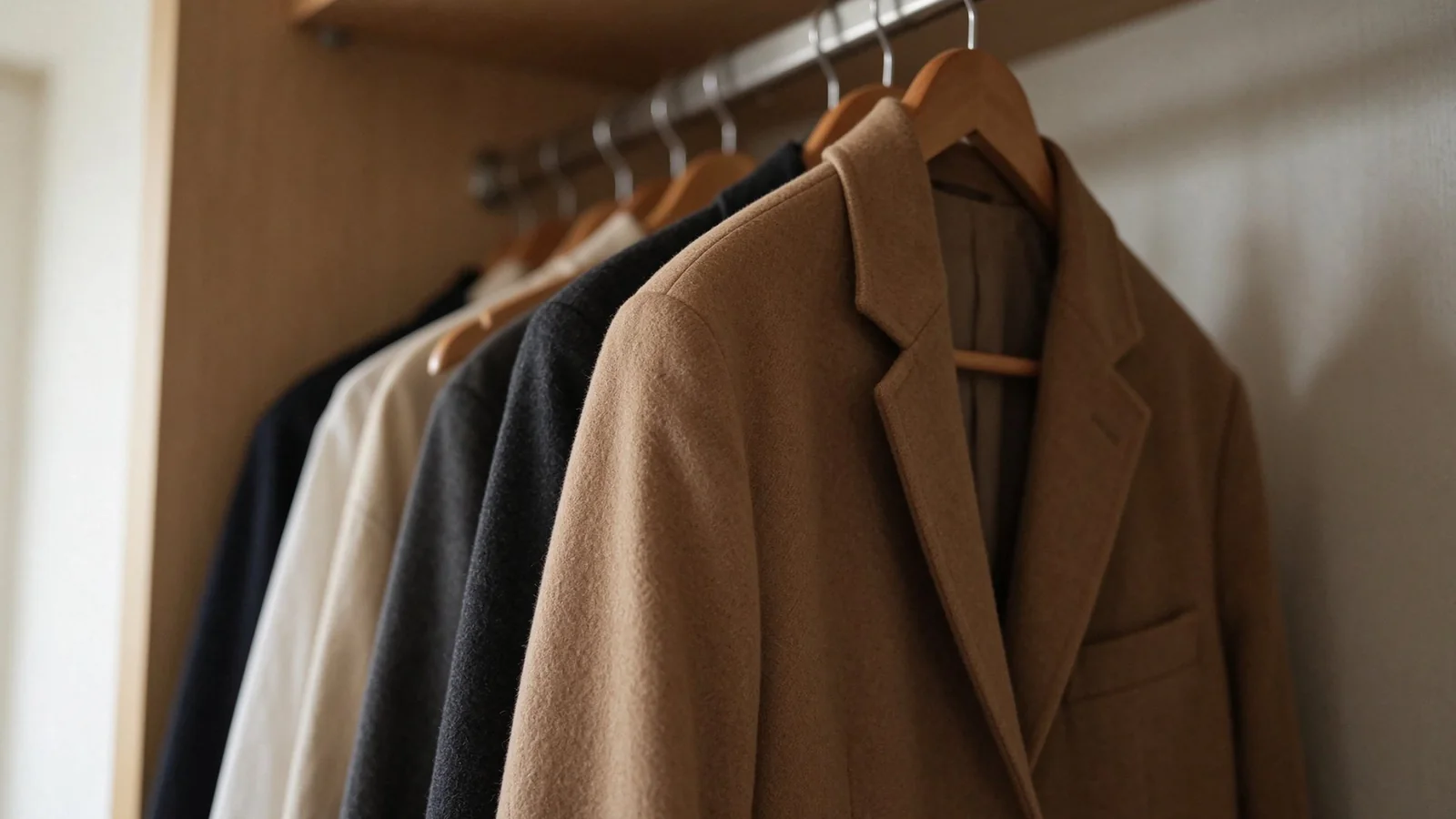
A hanger is bought by its thickness before anything else. Length decides whether the garment fits the wardrobe; thickness decides whether the hanger carries the garment at all. Two hangers of the same length and the same wood, one 4.5 cm across the shoulder and one 1.2 cm, are not variations of a product — they are products for different garments.
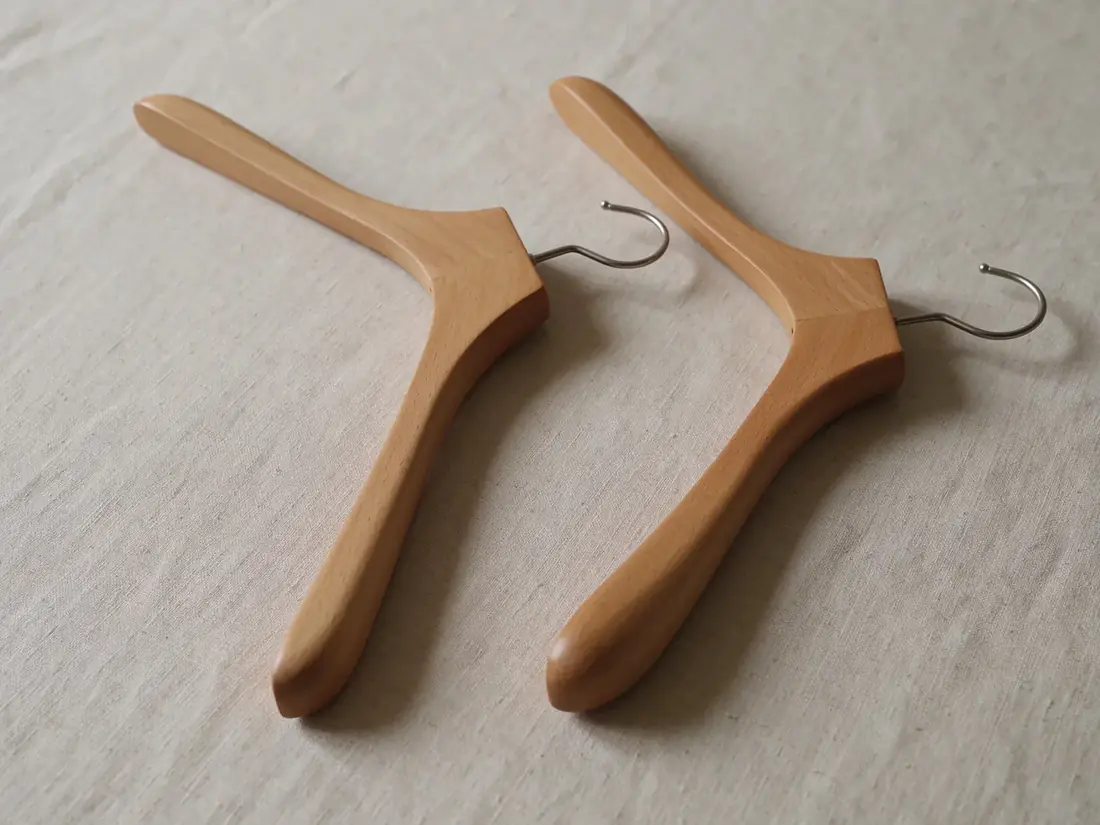
Most briefs specify length and wood and leave thickness to the factory. That is where a range gets under-specified on the heavy end and over-specified on the light end: a 4.5 cm shoulder on a T-shirt is a hanger that looks heavy and costs more than it needs to; a 1.2 cm frame under a wool coat is a hanger that dents the shoulder in a season.
What "thickness" measures
It is the depth of the hanger across the shoulder section, measured from the front face to the back face at the point where the garment rests. A coat hanger is thick there because the garment is heavy and the shoulder needs a broad surface; a T-shirt hanger is thin because the garment is light and the wardrobe is tight.
Thickness is not the same as the wood's slab thickness at the arm, and neither is it the length. Three numbers, three jobs: length for reach, thickness for support, slab for weight and feel. A specification that carries one of the three is one-third of a specification.
How thickness is measured in practice
Two measurements matter and they are taken differently. The shoulder-section depth is measured across the face of the hanger at the point where the garment rests, with a caliper or a depth gauge. The slab thickness is measured through the arm, and it is the number that decides how the hanger feels in the hand and how much the panel weighs.
For a written specification, name both and say which one you mean. "4.5 cm" alone is ambiguous between the two, and the ambiguity survives all the way to the sample stage, where it becomes an argument about whether the sample matches the brief.
Why the number is easy to get wrong by eye
A 3 cm hanger and a 4.5 cm hanger look similar in a photograph taken from the front, because the difference is in depth and the camera flattens it. Buyers comparing samples on a desk often choose the one that looks better finished rather than the one that is thick enough — which is why the sample test below asks for a garment, not a photograph.
The four thickness bands
The bands we quote
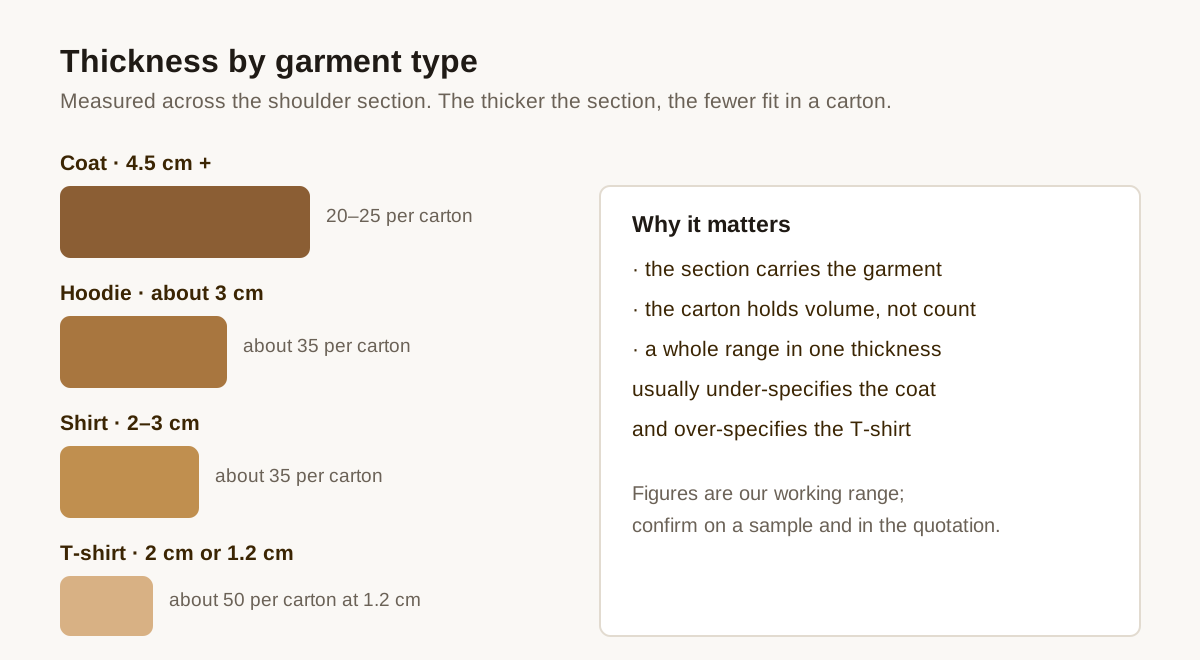
The bands are working ranges rather than standards. A coat hanger at 4.5 cm and a coat hanger at 5.2 cm are both coat hangers; the number that matters is whether the section is wide enough that the garment's weight is spread rather than concentrated.
What happens at the extremes
At the heavy end, above 5 cm, the hanger stops being a support and becomes a display fixture: it holds a coat open, shows the shoulder line and takes rail space accordingly. At the light end, below 1.2 cm, the frame starts to flex under a garment it was not designed for, and the hanger's own weight saving is offset by a shorter service life.
Both extremes are legitimate for their purpose and wrong outside it. The useful question is not "how thick should a hanger be" but "what is the heaviest garment this hanger will carry, and for how long".
Why 2 cm and 1.2 cm both exist for T-shirts
Two centimetres is the usual T-shirt frame where the hanger is also used for light knits. One point two centimetres is the budget and travel format: the thinnest frame that still holds a neckline, used where a property or a shop needs volume and rail capacity more than support.
The difference shows in the carton as much as in the room. The 1.2 cm frame packs about 50 to a carton; the 2 cm frame packs about 35. On a large order that is a freight decision before it is a product decision.
The thickness a buyer should not accept without a sample
Outside the four bands, "thick" and "thin" are not specifications. A supplier who quotes "thick wooden hanger" without a number is quoting a category; the sample will be whatever that factory calls thick. Ask for the measurement in centimetres and check it with a caliper on the sample — two minutes, and it settles the question.
Why a mixed order is the normal case
Almost no property or shop buys one thickness. A hotel buys coat hangers for outerwear and thinner frames for shirts; a boutique buys the heavier frame for the rail and the thin one for folded stock. The order usually carries two or three bands, each with its own minimum and its own carton count.
That is why the thickness list belongs on the order as separate lines rather than as an average. An order written as "600 hangers" cannot be quoted; an order written as "300 coat at 4.5 cm, 200 shirt at 3 cm, 100 T-shirt at 1.2 cm" can.
| Garment | Thickness | What the section does |
|---|---|---|
| Coat, heavy outerwear | 4.5 cm and up | broad contact surface for a heavy shoulder |
| Hoodie, knitwear, sweatshirt | about 3 cm | supports a soft, bulky garment without crushing it |
| Shirt, blouse | 2–3 cm | enough surface for a light garment, still compact |
| T-shirt, light top | 2 cm or 1.2 cm | minimum depth, maximum rail capacity |
Length by wearer
Men's and women's lengths
Length is chosen by the garment's shoulder width, not by the wearer's height. A men's 42 cm hanger on a women's tailored jacket leaves the shoulder tips unsupported; a women's 39 cm hanger under a men's overcoat pulls the shoulder in. Where a range serves both, the two lengths are two models on the order.
Why length and thickness are chosen separately
A coat needs length and thickness together: a 45 cm hanger is usually a 4.5 cm hanger as well, because the garment is heavy and long. A T-shirt needs neither: 41 cm of length on a 1.2 cm frame is the normal combination.
The pairing is a habit rather than a rule. A thick frame on a short length exists — a compact coat hanger for a tight wardrobe — and a thin frame on a long length exists for light dresses. Specify both numbers and the pairing follows the garment.
Short formats and where they belong
Below 39 cm the range becomes specialised: children's hangers, compact wardrobes in serviced apartments, and display formats where a garment is shown rather than stored. A 30 cm hanger on an adult jacket pulls the shoulders in and is a specification error; the same hanger in a child's wardrobe is correct.
For a hotel with family rooms, the children's hanger is a real line on the order and usually a stock item rather than a custom one, because the quantity is small and the type is standard.
What length does to the wardrobe
A hotel wardrobe is short. Four 45 cm hangers in a 60 cm rail sit at an angle; four 41 cm hangers sit flat. That is the one place where the shorter length is not a compromise but the correct specification, and it is decided by the wardrobe rather than by the garment.
| Wearer | Length | Notes |
|---|---|---|
| Men | 41–45 cm | 42 cm and 45 cm are the common working sizes |
| Women | 39–42 cm | 39 cm for tailored jackets, 42 cm for coats |
| Shorter formats | down to 30 cm | children, compact wardrobes, display |
What thickness changes on the garment
The support band
A jacket rests on the hanger across a band whose width is set by the thickness of the shoulder section. A thicker section spreads the same weight over more fabric; a thinner section concentrates it. That is the whole mechanism, and it is why the same garment can be fine on one hanger and marked on another.
What a mark looks like
Three failures, in the order they appear:
- a dent at the shoulder point, where the hanger's edge sits; - a shoulder line that bends inward toward the neck; - a crease along the top of the sleeve head, which is the one that does not recover.
A hanger can pass the first two and fail the third after a long hang. That is why a display rail, where a garment stays for weeks, is specified more heavily than a guest-room rail where it stays for a night.
Why a hotel and a shop specify differently
A guest-room hanger is judged by the guest in a wardrobe, at night, for a night. A display hanger is judged by a customer in a lit shop, at arm's length, for weeks. The first is a storage tool; the second is part of the product presentation.
That is why the same garment can be specified on different bands in the two settings without either being wrong. The hotel is buying storage that does not mark; the shop is buying presentation that holds a shape. The boutique programme and the hotel programme are built on that difference.
Why the wood matters less than the thickness
Buyers often start with the wood species — beech, lotus, walnut — because it is the visible choice. The species affects colour, cost and how the hanger takes a finish; the thickness affects whether the garment is held properly. Choose the thickness first, then the wood for the range it belongs to.
Thickness and the carton
The carton holds volume
A carton is filled by volume, not by count, so the number of hangers in it falls as the hanger gets thicker:
The exact count for an order is confirmed in the quotation, because packing method and carton size also move it. What matters for the buyer is the consequence: the same number of hangers becomes a different number of cartons depending on thickness, and cartons drive pallet height, container fill and the freight line.
A worked comparison
1,200 hangers in a 4.5 cm frame at 22 per carton is about 55 cartons. The same 1,200 in a 1.2 cm frame at 50 per carton is 24 cartons. Same count, less than half the cartons, and a very different landed cost per hanger — before the unit price is compared.
That comparison is the reason a mixed order should be quoted line by line. Averaging thickness across a mixed order produces a carton estimate that fits neither line.
Estimating cartons for a mixed order
Calculate each line separately, then add the cartons. A mixed order of 600 coat-band, 400 shirt-band and 300 T-shirt-band hangers comes to about 27 cartons for the coat line, about 11 for the shirt line and 6 for the thin line — roughly 44 cartons in three sizes rather than one round number.
The estimate is worth doing before the quotation, because the freight line depends on it and because a pallet that mixes carton sizes stacks differently from a uniform one. Where the property will store cartons by floor, mixing sizes on a pallet is a disadvantage; where the order goes to a distributor, it is normal.
What to write about packing
Three instructions are enough: thickness and model per line, units per carton as quoted, and the label rule — SKU, floor or room block. A property wants cartons labelled by floor; a distributor wants neutral cartons with their own SKU. Both are packing instructions and belong on the order.
The packaging side of a hotel programme is covered on the hotel programme page, and the carton and pallet question sits inside the hotel quantity method.
| Thickness | Hangers per carton (typical) |
|---|---|
| 1.2 cm | about 50 |
| 2–3 cm | about 35 |
| 4–4.5 cm | 20–25 |
Choosing for a mixed range
Start from the garment list
Sort the range by garment weight, then assign a thickness to each group:
Two or three bands cover most ranges. Where a range genuinely needs four, the fourth is usually a length variant rather than a new thickness.
How many bands a typical order carries
Two, in most ranges: a coat band and a shirt band, with the T-shirt band bought as a stock item rather than customised. Three bands appear where the range covers outerwear, tailoring and casualwear; four is rare and usually means the range is really two ranges.
Counting the bands before quoting is the fastest way to see whether an order is feasible. Four custom bands at 150 minimum each is a 600-piece minimum before the buffer; a buyer who expected a 400-piece first order needs to know that before the sample is made.
What a new thickness costs
If the band exists in our standard range, there is no tooling charge. If it does not — a 5.2 cm section, or a shape combined with a different length — the cost is a sample run plus a one-off tooling line, and both should appear as separate lines in the quotation rather than inside the unit price.
That distinction is worth asking about before comparing suppliers, because a quotation that folds tooling into the unit price cannot be compared with one that does not. The customized service page sets out how those lines are itemised.
The order consequence
Each band is its own model and carries its own minimum: 150 pcs per model and colour for custom lines, 10 pcs for stock lines. A small boutique may not reach four minimums, which is why ranges are usually built on two bands plus stock-line items for the rest.
Where the programme carries a logo, the mark is usually specified on the coat band and repeated on the thinner bands in a smaller size — the private-label route covers how the two are proofed together. The products page lists the models we keep in production by band.
| Garment group | Thickness | Length |
|---|---|---|
| Coats, heavy outerwear | 4.5 cm+ | 45 cm |
| Suits, structured jackets | 4.5 cm | 42–45 cm |
| Knitwear, hoodies | about 3 cm | 42 cm |
| Shirts, blouses | 2–3 cm | 41–42 cm |
| T-shirts, light tops | 2 cm or 1.2 cm | 41 cm |
| Display pieces | 4.5 cm | 45 cm |
The sample test
How to test a thickness
Take the heaviest garment in the range, hang it on each candidate for 24 hours in the conditions it will live in, and check four things: the shoulder point, the shoulder line, the sleeve head and the collar. Then repeat with the lightest garment, because a frame that is right for the coat can be too heavy for the shirt.
Making the result usable
One garment, one rail, one light, one day per candidate. Have the person who will live with the result sign it — housekeeping in a hotel, whoever dresses the window in a shop.
Testing two bands against one garment
Where the choice is between a 3 cm and a 4.5 cm frame for the same jacket, run both on the same garment on the same rail. A photo of the two shoulders side by side, taken the next day, settles the argument faster than any specification table — and it is the image a buyer can take to a purchasing committee.
What the test cannot tell you
It cannot tell you how the finish will wear, whether the next batch will match, or how the range will look under a shop spotlight at the end of a season. Those are answered by the specification, the batch record and the inspection, not by the test.
| What to check | Candidate A | Candidate B | Verdict |
|---|---|---|---|
| Shoulder point | |||
| Shoulder line | |||
| Sleeve head | |||
| Collar |
What we can and cannot promise
We can promise that the thickness on the order is the thickness produced, that the sample will be made against it, and that the batch is inspected against the same sample. We can tell you which band suits which garment group from the ranges we produce.
We cannot promise that a 3 cm frame will suit a garment we have never seen, or that a half-centimetre difference will settle a shoulder question on a particular jacket. That is decided on a sample with the garment in hand — which is why the sample exists and why the sampling window is 7–15 days rather than an email.
What to write on the order
The models we keep in production by band are on the products page and in the wide-shoulder range; trouser bars and clips follow the same thickness logic on their own pages. The four specification decisions — wood, thickness, finish and logo — are priced together in customisation; the checks a batch passes are on the quality page; and the specification sheet guide covers the fields a written brief should carry.
Specification sheets carrying the thickness and length per model can be requested from the downloads page, the full design method is in the hanger specification guide, and the commercial answers are in the FAQ. If the range also needs a logo or per-floor packing, those sit inside the customized service we quote.
Send the garment and we will tell you which band we would sample first. None of these figures is a standard. Where a garment has not been sampled, the sample decides — not the table.
| Field | What to write | Why |
|---|---|---|
| Thickness | 1.2 / 2 / 3 / 4.5 cm, by model | the field that decides support and carton count |
| Length | 41–45 cm men, 39–42 cm women | reach and wardrobe fit |
| Wood | beech, lotus, ash, balata, birch, cedar or walnut | colour and cost band |
| Finish | gloss, matt or satin with a sample reference | appearance under light |
| Garment | the heaviest garment the hanger must carry | the input the thickness is chosen from |
| Packing | units per carton as quoted, label rule | freight and receiving |
FAQ