
Why a reorder stops matching
Two years after a room block is installed, a property orders again. The hangers arrive on time, the shape is right, and something is wrong: under the wardrobe light the new ones read slightly darker, or slightly warmer, than the ones already hanging. Individually each set is fine. Side by side in the same room, they are two different hangers.
This is the ordinary behaviour of a natural material, not a defect. Wood varies between lots, finish varies between batches, and tooling wears over thousands of pieces. What makes a reorder fail is not that variation exists; it is that nobody recorded the batch it was supposed to match.
What a mismatch looks like in practice
Three versions, in the order they appear. First a tone difference: the new hangers read warmer or cooler than the old ones under the wardrobe light. Second a surface difference: the new lacquer is slightly more matt or slightly more glossy, which shows at the angle a guest looks into the wardrobe. Third a mark difference: an engraved logo that is shallower or sharper than the one next to it.
Only the first is visible in a photograph. The other two are visible in the hand and in the room, which is why the sample — not the photograph — is the record that matters.
What a guest actually notices
Guests compare what is in front of them — the hangers in one room, in one wardrobe, at one light. They do not compare rooms, floors or photographs. That is the entire basis of the mixing rule in this article: a difference that is invisible inside a room is manageable; a difference inside a room is not.
What the buyer is actually buying on a reorder
Not hangers — continuity. The second order exists to keep the first order's rooms looking like one property, and that is a service rather than a product. It is why the batch record, the retained sample and the floor-level mixing plan belong in the same conversation as the price.
A supplier that quotes a reorder without asking about the batch is quoting a new product. A buyer who accepts that quote is buying a new product at a reorder price, and will find out when the floors start to differ.
Why the problem is invisible until it is a complaint
At delivery, the new hangers are inspected against the new order. Nobody opens an occupied room and compares a new hanger with a two-year-old one, because the new stock goes to the store. The mismatch surfaces weeks later, in a room where a lost hanger was replaced from a mixed spare box — which is why the spare-box rule matters as much as the batch record.
The four things that drift
Wood lot
Solid wood is bought in lots. Two lots of beech are unlikely to be identical in tone after finishing, because grain, porosity and the natural colour of the board vary. The finished colour of the same lacquer over two lots can differ enough to see side by side.
Lotus and walnut move more than beech in tone, and a finish that is pigmented rather than clear increases the visible difference, because the pigment sits over the grain rather than letting it read through.
Finish batch
Lacquer is mixed per run. The same product code mixed on different days can carry a slight tint difference, especially where colour is matched by eye against a standard rather than mixed to a measured formula. A property that approved a sample under one batch's tint is comparing the next batch against a physical object, not against a number.
Tooling and profile
Engraving and stamping tools wear. Over tens of thousands of pieces the mark gets shallower or sharper, and the difference is visible next to an older hanger. Profile shape moves less, but a well-used mould does eventually change the edge.
Packing and dimensions
The least discussed and most common source of "these are not the same": a different carton count, a different inner protection, or a millimetre drift in panel thickness between runs. None of these change how the hanger looks on the rail; all of them change how it arrives and how the store counts it.
How much difference is visible
There is no single number, and anyone quoting one is simplifying. Visibility depends on the light in the room, the colour of the finish, the angle the wardrobe is viewed from, and whether the two hangers are hanging side by side. Two batches that look identical under a shop spot can differ under a warm guest-room lamp.
The practical answer is to agree a tolerance on the sample rather than argue about numbers in an email: approve the sample the way it will be seen, then hold the next batch against it under the same light.
What it means for the order
| Source | What it looks like | Prevented by |
|---|---|---|
| Wood lot | tone difference under the same finish | naming the lot on the batch record |
| Finish batch | slight tint shift, warmer or cooler | retained colour sample per batch |
| Tooling wear | shallower or sharper logo | tooling recorded and inspected at proof |
| Packing and size | different carton, panel drift | packing spec and measured sample in the record |
The five records that make a match
What we keep
Five items, held long-term rather than until the invoice is paid:

1. the approved physical sample; 2. the colour reference the sample was approved against; 3. the written specification — thickness, length, wood, finish, logo method and position; 4. the production dates for the batch; 5. the inspection result for that batch.
Together they answer the only question a reorder asks: what exactly was made last time, and can it be made again.
Why the sample is the anchor
A photograph cannot settle a colour question. Screens differ, cameras differ, and a glossy finish photographs badly by default. The approved sample is the object the next batch is measured against, which is why it has to survive on a shelf rather than in an email thread.
Why the specification matters as much as the sample
The sample shows the result; the specification shows the inputs. A supplier handed only a sample can reproduce the look but not the process — and process is what makes a second batch affordable, because it avoids re-sampling the whole item.
How the records travel with the order
The specification and the sample stay with the factory; the property keeps a copy of the sheet. When a reorder is placed, the factory pulls the sample and the record and confirms what the new batch will be measured against — ideally before quoting, because the answer decides whether it is a repeat or a new specification.
That confirmation step is cheap and rarely skipped by a careful supplier. It is also the point where a buyer learns that the finish system has changed, or that the wood lot is different, before the order rather than after delivery.
What a property should ask for
A one-page copy of the five records, filed with the purchase order. It costs the supplier a minute and saves the property a renegotiation, and it is the difference between a reorder and a restart. Where a property changes supplier, the sheet is also what makes the new quote comparable.
| Record | Who holds it | What it answers |
|---|---|---|
| Approved sample | factory, long-term; copy with property | what the last batch looked like |
| Colour reference | factory, with the sample | what the colour was matched to |
| Written specification | factory and buyer | what was actually ordered |
| Production dates | factory | which run to compare against |
| Inspection result | factory | whether that run passed |
When the original batch is gone
The realistic case
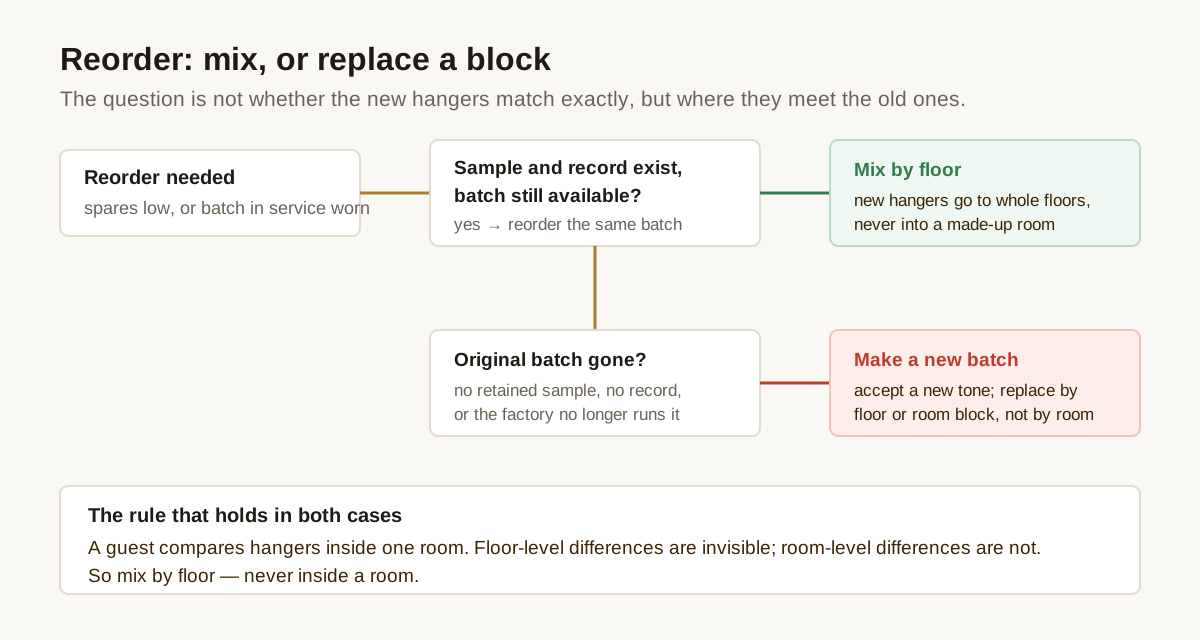
Runs end. A lot is used up, a lacquer line moves on, a tool is retired, or the factory stops producing a particular model. Sooner or later a reorder is not a reorder at all — it is a new batch of the same design.
The workable answer is to make a new batch and manage where it meets the old one. Pretending the new batch will match exactly is where projects go wrong: the factory quotes the cheapest sensible option, the property expects continuity, and the difference appears in a room three months later.
How to know the batch is gone before the order
Ask before quoting: is the tool still running, is the finish system the same, is the wood lot still available. Three questions, answered in one email, and they determine whether the order is a repeat or a development.
Most mismatches we see came from this step being skipped rather than from a factory changing something without telling anyone. The information usually exists; nobody asked for it at the quoting stage.
What to plan for when a new batch is inevitable
Three decisions, taken before the order rather than after:
- Scope the batch. Replace a whole floor or a whole room block rather than topping up room by room. - Choose the moment. A refit, a seasonal closure or a wing refurbishment is the natural point to change tone without anyone noticing. - Keep the old stock as spares. Old-batch hangers go into the spare box for the rooms that still carry them, and the box is labelled with its batch.
How the new batch is set up
A new batch starts with a new sample, approved by the property under the light it will live in. The sample carries the new colour reference, and the specification is updated to match — which matters later, because the next reorder should reference the new batch and not the old one.
That is the quiet administrative cost of a batch change: two record sets, one for the old rooms and one for the new. A property that keeps both can maintain two floors on two batches without confusion; a property that keeps neither ends up with a mismatch nobody can trace.
Why "make a new batch" is often the right commercial answer
Re-sampling to match an old batch can cost more than making a clean new one, and it still may not match under every light. Where the property can absorb the change at floor level, a new batch with a new sample is faster, cheaper and more predictable than an attempt to reconstruct an old tint.
Mixing old and new
The rule
Mix by floor, never inside a room. A guest compares hangers within one room; a difference between floor 3 and floor 5 is invisible to them. A difference between two hangers in the same wardrobe is the one that gets photographed.
How to apply it in practice
Sort the delivery by floor before it reaches housekeeping. If the new batch is ten percent of the property, it goes to the floors that need it most — the ones already carrying the most replacements — rather than being spread thinly everywhere.
Briefing housekeeping
The people who will inadvertently break the rule are the ones who make up the rooms. A two-line briefing is enough: new hangers are for floors 6 and 7 only; old spares are in the box marked with the old batch and stay on floors 1–5. Without that, the rule lasts until the first lost hanger.
Where the property has a housekeeping app or a shift handover note, put it there rather than in an email. Instructions in an email are read once; instructions in a handover note are read every week.
What to do with the spare box
The spare box is where mixing starts. Keep it labelled by batch, and when a new batch arrives, retire the old spares into a separate box for the floors still on the old batch. One label is the difference between a controlled transition and a property that looks like it was furnished twice.
How to plan a floor change
Pick the floors by occupancy first: the ones with the highest turnover absorb a change fastest, because the rooms are remade more often and the tone settles in. Then change in one move — a floor half-changed is worse than a floor not started.
For a large property, the natural intervals are a seasonal closure, a wing refurbishment or a change of soft goods. Those are already moments when rooms look different; a batch change hides inside them.
When mixing is unavoidable
Small properties with irregular occupancy sometimes have to mix inside a floor. The next best rule is to mix inside a room type rather than a room: all standard rooms on a floor change together, so the room-to-room comparison at least stays consistent.
Reorder timing and quantities
When to reorder
When the spares fall below the agreed level, or when the batch in service no longer matches the retained sample. Both triggers should be written into the property's maintenance routine rather than noticed by chance.
How much to reorder
The quantity follows the same room-block arithmetic as the first order, with one change: the buffer is usually smaller on a reorder, because the property now has a year or two of its own loss data instead of an estimate. Ten percent is a common reorder buffer where the first order carried fifteen.
Who owns the reorder
Three people, three parts: housekeeping reports the spare level, purchasing raises the order, and the supplier confirms the batch reference. The failure mode is a reorder raised by purchasing without the batch reference, which produces a new batch when a repeat was still possible.
The fix costs one line on the purchase order template — a batch field — and it is the single cheapest improvement a property can make to its hanger programme.
How long it takes
Twenty-five to thirty-five days after artwork approval for a reorder of an existing specification, because the sample and the specification already exist. A new profile or a new logo method adds the 7–15 day sampling window on top; that is the price of changing the specification rather than repeating it.
What to write on a reorder
Eight lines are enough, and each one has a reason:
A reorder template
A reorder written this way takes two minutes and removes most of the correspondence around it.
The last line is the one that gets forgotten. A reorder that quietly changes the packing, the finish sheen or the logo size is not a reorder; it is a new product with the same name, and the property will discover the difference at the rail.
| Field | What to write | Why |
|---|---|---|
| Model or product code | the code from the original order | avoids re-describing the shape |
| Batch reference | original batch date or number | tells the factory what to match |
| Sample | whether a physical sample is supplied | the only reliable colour reference |
| Quantity | per model and colour | mirrors the first order's structure |
| Buffer | percentage, on its own line | keeps the spare stock visible |
| Packing | units per carton as quoted, label rule | receiving and distribution |
| Destination and date | port and required date | sets the production window |
| Change note | anything that differs from last time | prevents a quiet substitution |
| Line | Example shape | Note |
|---|---|---|
| Model | the code from the first order | do not re-describe the shape |
| Batch | the original batch date | what to match |
| Quantity | per model and colour | mirrors the first order |
| Buffer | percentage | separate line |
| Packing | as quoted, with label rule | per floor or SKU |
| Destination | port and date | production window |
| Change | "none" or what changed | prevents substitution |
What cannot be matched
Honest limits
Wood is a natural material. Two batches of the same species, from the same supplier, finished to the same specification, can still differ enough to see side by side. A supplier who promises an exact match across years is promising something the material does not allow.
What can be promised is a match within an agreed tolerance, measured against the retained sample under an agreed light, and a process that keeps the records needed to get close. The quality page sets out what each batch is checked against; colour is one of those checks, recorded against the sample rather than a photograph.
What a new batch actually changes
It changes the colour reference, the sample, and the batch record — not the shape. A property moving to a new batch keeps the same model, the same thickness and the same length; what changes is the tone and the date stamped on the record.
That distinction matters commercially: a new batch is a repeat order of a known product, priced as production rather than development, as long as the specification does not change. Where the specification does change — a different finish system, a different wood — it becomes a new product and carries sampling again.
Where the limit shows up
Three places, in order of frequency: a top-up order placed years after the original, a change of wood lot mid-programme, and a change of finish system — for example moving from a solvent to a water-based lacquer. The last one changes the look as well as the process, and it should be treated as a new specification rather than a reorder.
What to do about it
Plan the transition rather than avoid it. A property that knows a batch change is coming can choose the floor, the month and the scope; a property that discovers it has no choices left. The hotel programme covers room-block ordering, the hotel quantity method covers the arithmetic that a reorder repeats, and the thickness guide explains why a batch change is usually a tone change rather than a shape change.
The specification behind the record is set out in the hanger specification guide and in the specification sheet article. The product lines a reorder would reference are on the products page, the finish and logo decisions on customisation, and the batch checks on quality. Specification sheets and packing data can be requested from downloads, and the commercial answers sit in the FAQ.
If the programme is a distributor range rather than a property, the same logic applies one level up: the carton label and the batch split sit in the distributor programme, and the service scope — what is quoted separately — is on the customized service page.
Send the batch reference and one sample, and we will tell you what can be matched and what has to be a new batch.
FAQ